Transform confusing library spaces into clear pathways with jargon-free signs and intuitive navigation.
Imagine standing at the entrance of an academic library, faced with multiple pathways, various service points, and an array of signs using unfamiliar terminology.
For many library users, this experience can be overwhelming and create unnecessary barriers to accessing resources and services.
Traditional library signage often relies heavily on jargon and assumes prior knowledge of library terminology and services, leaving users to question basic but crucial information:
The Challenge of Navigation
Academic libraries present unique wayfinding challenges.
With their complex layouts, multiple service points, and various study zones, these spaces can create what the Autism-Friendly University Design Guide (Mostafa, 2021) describes as an "overwhelming visual environment."
Poor sight lines, hidden service points, and inconsistent signage further complicate navigation for all users, regardless of their familiarity with library spaces.
Rethinking Traditional Approaches
Clear communication starts before users approach any service point.
Consider the traditional "Reference Desk" or "Information Desk" sign. While librarians understand this terminology, many users wonder: What kind of help can I get here? Instead, direct language like "Ask a Librarian" provides clear guidance about the service available.
Similarly, replacing "Circulation Desk" with "Check Out Books Here" removes the barrier of library jargon and clearly communicates the function of the service point.
Supporting Different Navigation Styles
Just as we recognize that users have different learning styles, they also have different navigation preferences. Some rely heavily on visual cues, while others prefer text-based directions or digital tools.
By providing multiple formats for wayfinding information, we create an environment that supports various navigation strategies:
- Physical signage with both text and icons
- Digital maps accessible through QR codes
- Downloadable floor plans
- Virtual tours for preview before visits
- Clear sight lines to service points
Creating Clear Pathways
The identification of "clear, distinct and continuous" pathways helps alleviate anxiety and supports navigation through library spaces (Mostafa, 2021).
This means developing consistent naming conventions across spaces, implementing clear visual markers, and providing multiple formats for directional information.
Both text and icons should be used to indicate not just the name of a space, but its function, helping users anticipate what they'll encounter in different areas of the library.
Clear Communication of Sound Zones
One of the most crucial aspects of library wayfinding is clearly communicating noise expectations throughout the space.
Different users have varying needs when it comes to sound levels some require complete quiet for focus, while others work better with background noise or need opportunities for group discussion.
Clear, consistent signage about noise levels helps users make informed decisions about where to study and reduces anxiety about appropriate behavior in different spaces.
Implementing Sound Zone Signage
Effective noise level communication goes beyond simple "Quiet Zone" signs. Consider implementing a clear system that might include:
- Quiet Study Areas: For silent, individual work
- Low-Conversation Zones: Where whispered discussion is acceptable
- Group Study Spaces: For collaborative work and normal conversation levels
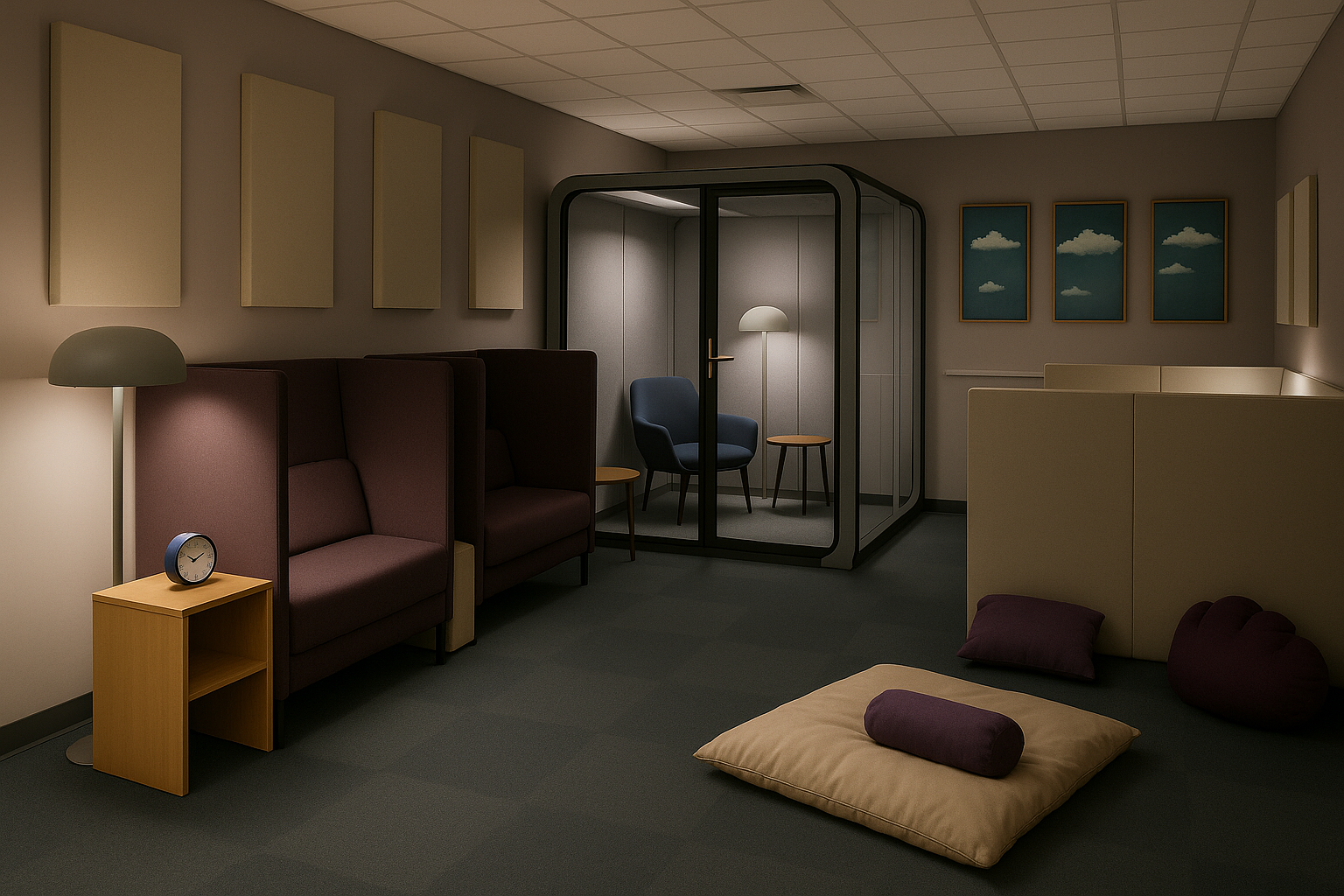
This zoning should be supported by physical design elements. As noted in the Autism-Friendly University Design Guide (Mostafa, 2021), sound-proof group study rooms and separate sections for solo and collaborative work help maintain these distinct zones effectively. The guide also emphasizes the importance of sound-dampening materials and proper space planning to prevent noise bleeding between areas.
Sequential Navigation: Creating Logical Pathways
Think of library navigation as telling a story, one that unfolds naturally as users move through the space.
The Autism-Friendly University Design Guide (Mostafa, 2021) emphasizes the importance of creating logical sequences that flow from high-stimulation to low-stimulation areas, with strategic transition points along the way. This sequential approach helps users anticipate and prepare for different experiences within the library space.
Building Navigation Stories
Just as we naturally progress through a narrative, library spaces should offer clear pathways that guide users from one area to the next. Consider the journey from the bustling entrance area through increasingly focused study spaces, culminating in quiet individual study areas. This progression mirrors what the AFU Design Guide describes as a "flow of activities," moving from public spaces through transitional areas to more secluded zones (Mostafa, 2021).
The key is creating what Universal Design principles call "simple and intuitive" navigation (Scott, McGuire, and Shaw, 2003). This means implementing consistent visual markers, clear sight lines, and regular orientation points that help users maintain their bearings. Rather than relying on complex wayfinding systems, the focus should be on creating obvious pathways that naturally guide users to their destinations.
Safety and Support in Navigation
While creating quiet and isolated study spaces is important, the AFU Design Guide (Mostafa, 2021) reminds us to balance the need for separation with safety considerations. This might include:
- Visual access from external spaces
- Strategic placement of service points
- Clear emergency procedures
- Easy access to help when needed
Technology as a Navigation Aid
Modern wayfinding often incorporates digital tools to supplement physical signage. Many users, particularly those who are neurodivergent, prefer to preview spaces before visiting them in person. Providing virtual tours, downloadable maps, and clear photos of key service points helps reduce anxiety and supports independent navigation.
By implementing these principles thoughtfully, we create spaces that support all users in finding their way confidently and independently through the library landscape.
Creating Pathways to Success
Effective wayfinding in academic libraries isn't just about signs and arrows. It's about creating an environment where all users can navigate confidently and independently.
As we've seen, thoughtful implementation of clear signage principles, from replacing jargon with direct language to creating logical activity sequences, supports the estimated 15-20% of our population who are neurodivergent while benefiting everyone (Doyle, 2020).
The AFU Design Guide's (Mostafa, 2021) emphasis on spatial sequencing reminds us that navigation should flow naturally, like a well-told story, from high-stimulation to low-stimulation areas with appropriate transition zones. When we combine physical wayfinding elements with digital tools and multiple formats for accessing information, we create an inclusive environment that truly supports universal access.
Remember that successful wayfinding isn't about creating separate systems for different users. It's about implementing universal design principles that work for everyone while reducing anxiety and cognitive load. By continuing to assess and adapt our wayfinding strategies based on user feedback, we ensure our libraries remain accessible, navigable spaces where all users can focus on what matters most: learning and discovery.
References
Doyle, N. (2020). Neurodiversity at work: A biopsychosocial model and the impact on working adults. British Medical Bulletin, 135(1), 108–125. https://doi.org/10.1093/bmb/ldaa021
Mostafa, M. (2021). The autism friendly university design guide. Autism Friendly DCU.
Scott, S., McGuire, J., & Shaw, S. (2003). Universal Design for Instruction: A new paradigm for adult instruction in postsecondary education. Remedial and Special Education, 24(6), 369-379.