
Neurodiversity
Libraries

Discover how escape spaces transform libraries from overwhelming to welcoming for all minds.
As an AuDHD librarian, I understand firsthand the vital importance of escape spaces in academic libraries. These spaces aren't just nice-to-have amenities. They're essential features that can make the difference between a successful library visit and an overwhelming experience. The mere knowledge that such spaces exist can reduce anxiety and help users feel more confident navigating our libraries.
Understanding the Need
With 15-20% of the global population being neurodivergent (Doyle, 2020), the need for escape spaces isn't just a niche accommodation. It's an essential service that benefits many of our library users. This need becomes even more critical in academic settings, where neurodivergent students often face additional challenges, as evidenced by the fact that only 38% of autistic students complete a college degree compared to 60% of neurotypical students (Kuder & Accardo, 2018, as cited in Wischnewsky, 2023).
Different neurodivergent traits create varying needs for escape spaces. Those with anxiety often feel overwhelmed in busy spaces and need clear escape routes with predictable routines. ADHD-H individuals process information better while active and need movement opportunities. Autistic individuals may experience sensory sensitivities and notice details others miss, making quiet, controlled environments crucial. Those with ADHD-I need extra processing time and benefit from focused, distraction-free zones.
The Power of Choice
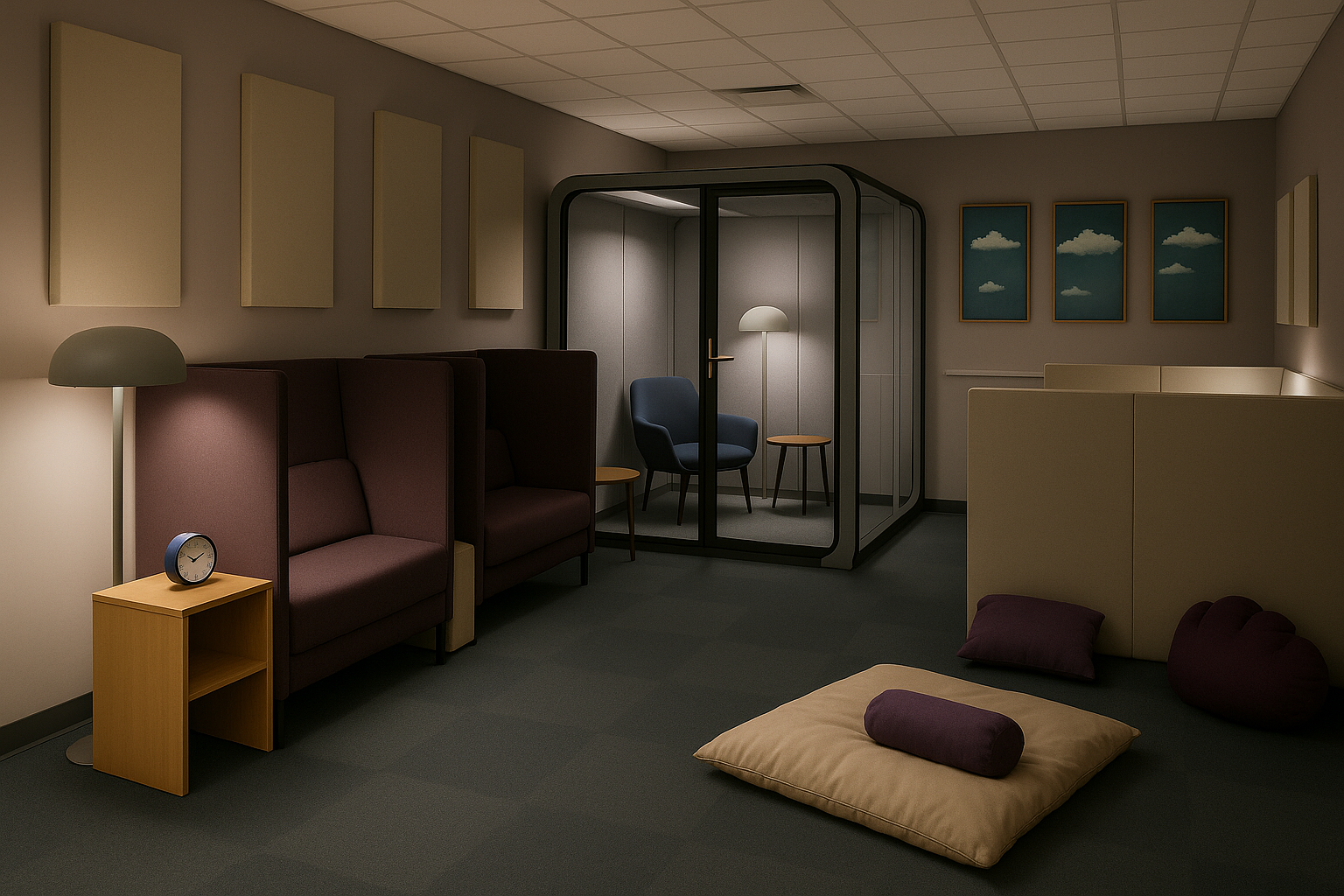
As the Autism-Friendly University Design Guide (Mostafa, 2021) emphasizes, escape spaces should be designed along a gradient from fully enclosed, quiet individual spaces to larger, more open areas that allow for safe social interaction. This spectrum of options provides users with choices to fulfill their needs as they arise while supporting skill development in sensory management and social interaction.
These spaces serve multiple purposes:
Implementing Effective Escape Spaces
Creating effective escape spaces requires thoughtful design considering physical and sensory elements. The AFU Design Guide emphasizes the importance of "spatial sequencing," organizing spaces in a flow that moves from low to higher stimulation areas, with clear transition zones where sensory jumps are unavoidable.
Creating Transition Zones
Think of transition zones as sensory airlocks. These spaces allow users to adjust gradually between different environments. For example, when moving from a busy collaborative area to a quiet study space, a transition zone might feature:
Managing Sensory Elements
Effective escape spaces need to be more than just quiet rooms. They should offer:
Setting Clear Expectations
The success of escape spaces depends largely on how well users understand their purpose and availability. To accomplish this goal and create awareness, this means:
Assessment and Continuous Improvement
Creating effective escape spaces requires ongoing attention and refinement. Our assessment strategies must reflect the diverse ways our users experience and interact with these spaces. Through careful observation and feedback collection, we can ensure our escape spaces serve their intended purpose while remaining adaptable to changing needs.
Understanding usage patterns tells us more than just how often spaces are used. It reveals the rhythm of our users' needs throughout the day. We gain valuable insights into the flow of activities across campus by paying attention to when and how these spaces are accessed.
Feedback collection must be as diverse as our user population. Some users prefer written feedback, while others communicate more effectively through conversation or digital means. By providing multiple channels for feedback, just as we provide multiple means of engagement in our spaces, we ensure everyone has a voice in shaping these environments. This might mean collecting anonymous surveys, engaging in informal conversations, or providing digital feedback options that users can access when and where they feel most comfortable.
Most importantly, we must remember that assessment isn't about achieving perfection. It's about continuous improvement. The ultimate measure of success isn't just in usage statistics or feedback forms. It's in creating environments where all users feel supported in their academic journey. When we design spaces that work for neurodivergent users, following the principle that what's essential for some benefits all, we create better spaces for everyone.
Making Feedback Accessible: QR Codes and Beyond
How to Implement:
Questions to Consider in Your Feedback Form:
Make the form inclusive by:
Universal Design
Remember to follow Universal Design principles by ensuring the feedback system is:
This approach creates multiple pathways for users to share their experiences while maintaining privacy and reducing barriers to participation. By offering various ways to respond, we acknowledge and respect different communication preferences and needs.
Making Responsive Adjustments
Creating truly inclusive escape spaces requires careful attention to what the AFU Design Guide calls an "empathy-driven, human-centered approach." When adjusting these spaces, we must consider how changes might affect different users unexpectedly. For instance, adding textured materials for sensory feedback might create mobility barriers for other users, while increasing visual sight lines could create sensory overload for some.
This complexity is why incremental improvements are so crucial. Rather than implementing sweeping changes, we test modifications in small steps, gathering feedback at each stage. For example, when adjusting lighting options, we might introduce task lighting in one area before expanding to others, ensuring the change serves its intended purpose without creating unintended barriers.
Clear communication about changes is essential for maintaining trust and predictability. When we modify spaces, we need to announce changes through multiple channels, visual guides, text descriptions, and walk-through opportunities. This aligns with Universal Design principles of providing multiple means of engagement and representation.
Most importantly, we must remember that solutions that work for one group shouldn't create new barriers for others. As the AFU Design Guide emphasizes, our goal is "intersectional design which does not create more exclusion while attempting to be more inclusive." We must constantly ask ourselves:
By maintaining this careful balance between improvement and inclusion, we create spaces that truly serve our diverse community while upholding the principle that what's essential for some benefits all.
References
Doyle, N. (2020). Neurodiversity at work: A biopsychosocial model and the impact on working adults. British Medical Bulletin, 135(1), 108–125. https://doi.org/10.1093/bmb/ldaa021
Mostafa, M. (2021). The autism friendly university design guide. Autism Friendly DCU.
Wischnewsky, L. A. (2023). Empowering autistic college students: Recommendations based on a review of the literature and existing support programs. Journal of College Academic Support Programs, 6(1), 38–47.